Prayer Times Worldwide

Accurate Fajr, Dhuhr, Asr, Maghrib and Isha times for cities in over 200 countries. Find your city or browse by region.

Five daily prayers
  1. FajrBegins at dawn, before sunrise.
  2. DhuhrAfter the sun passes its highest point.
  3. AsrIn the afternoon.
  4. MaghribJust after sunset.
  5. IshaAfter twilight, at night.

Pick a country to browse its cities, or go straight to a city.

Browse prayer times by country

Select a country, then your city, to see today’s schedule.

Calculation Methods

Different organisations define the angles used to calculate Fajr and Isha. Musulman uses the method most appropriate for your location.

Muslim World League (MWL)

Fajr: 18°, Isha: 17°. Used widely in Europe, Far East and parts of America.

Islamic Society of North America (ISNA)

Fajr: 15°, Isha: 15°. Standard across North America.

Egyptian General Authority of Survey

Fajr: 19.5°, Isha: 17.5°. Used in Africa and parts of the Middle East.

Umm al-Qura University, Makkah

Fajr: 18.5°, fixed 90-minute Isha. Used in Saudi Arabia and neighbouring countries.

University of Islamic Sciences, Karachi

Fajr: 18°, Isha: 18°. Used across Pakistan, Afghanistan, Bangladesh and India.

About Prayer Times

The five daily prayers are calculated from the position of the sun at your latitude and longitude. Times shift gradually throughout the year as the Earth orbits the sun.

  • Times are shown in local time for each city.
  • Jumu'ah (Friday prayer) replaces Dhuhr for men.
  • In high-latitude regions some methods apply special rules during summer.
  • The Azan is typically broadcast a few minutes before the official start time.

More from Musulman

Free Islamic tools, all in one place

Frequently Asked Questions

Answers to common questions about prayer times

How are prayer times calculated?
Prayer times are calculated using the position of the sun relative to your latitude and longitude. The angles for Fajr and Isha vary by calculation method (such as MWL, ISNA or Karachi). Dhuhr is at solar noon, Maghrib is at sunset and Asr is calculated from shadow length.
Which calculation method does Musulman use?
Musulman automatically selects the calculation method most commonly used in your region. For example, Umm al-Qura is used for Saudi Arabia, ISNA for North America and the Karachi method for Pakistan and Bangladesh.
Why do prayer times differ between cities in the same country?
Prayer times depend on the precise longitude and latitude of a city, as well as its time zone and elevation. Cities further east see sunrise and sunset earlier, so their prayer times are shifted accordingly.
What is the difference between Azan time and prayer start time?
The Azan (call to prayer) is traditionally broadcast a few minutes before the actual prayer start time to give people time to prepare. Musulman shows the calculated start time for each prayer.
How accurate are the prayer times?
Musulman calculates prayer times using established astronomical algorithms and applies the calculation method recognised in each country. Times are accurate to within one minute for most locations.
Can I see prayer times for a year ahead?
Yes. On any city prayer times page you can browse by month and download a printable annual timetable. The annual calendar is especially useful during Ramadan for planning Sehri and Iftar.

Every prayer, one glance away.

Free on iPhone. Prayer times, a Qibla compass and your daily timetable, built to be useful from Sehri to Iftar.

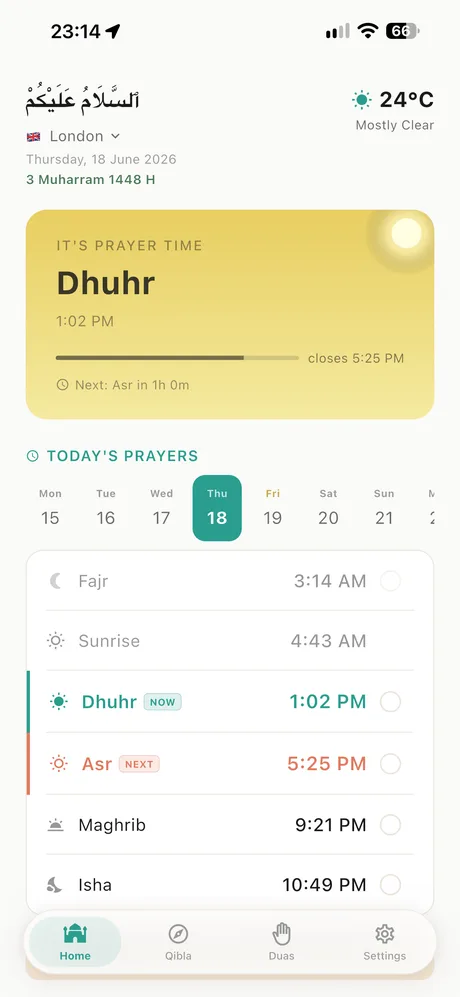
  • Prayer times on your lock screen and home screen. A live countdown and widgets keep the next prayer in view.
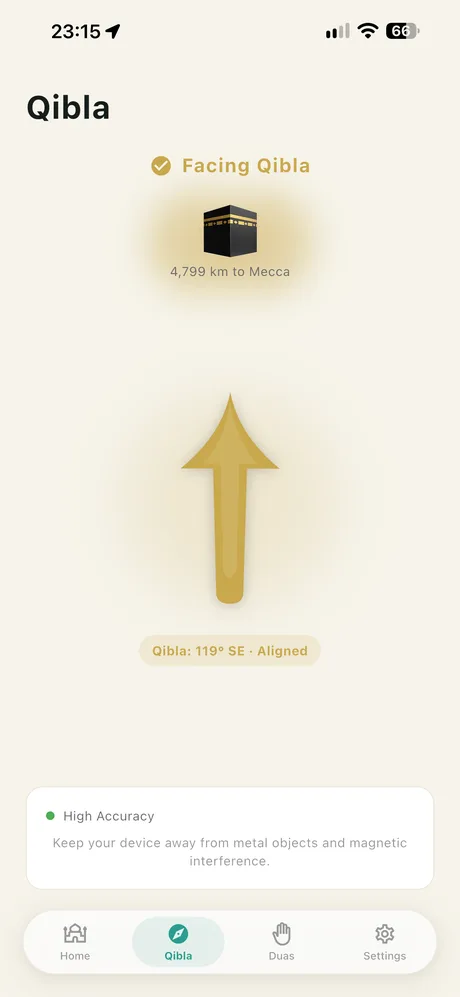
  • A Qibla compass that confirms when you face it. With the distance to Mecca.
  • Duas, always in reach. Open them any time from the app.
  • Available in many languages. Use the app in the language you are most at home in.
Download on the App Store
4.9 on the App Store
QR code to download Musulman on your iPhone
Get it on your iPhone Point your camera at the code to open the App Store.